
A new report by CIEL HR indicates a massive 260 per cent year-on-year surge in demand for Agentic AI engineers in India by 2026. This growth highlights AI's increasing role in automating routine tech functions and the evolving landscape of technology skills, prompting organisations to invest in reskilling and talent development to meet the rising demand for AI, cloud, and cybersecurity expertise.

TeamLease EdTech Founder and CEO Shantanu Rooj states that the AI-driven world transition is irreversible, with regulation and cost being crucial factors determining its speed and depth. He emphasizes that while AI will transform jobs, not eliminate them, continuous learning, domain expertise, and adaptability will be key for individuals and businesses to thrive in this evolving landscape. Rooj also highlights the need for universities to adapt their curricula to prepare a future-ready workforce.

India has secured a spot among the top 10 leading emerging-market performers in artificial intelligence (AI) readiness, with private investment in AI more than tripling to USD 4.1 billion in 2025, according to a new World Bank report.

Workday, a global HR tech major, has unveiled its new AI platform, Sana, designed to automate human resources and finance functions. Chairman and CEO Aneel Bhusri stated that AI is likely to replace low-cost, outsourced jobs due to increased productivity, rather than leading to jobs moving out of first-world countries. The platform uses AI agents for tasks like payroll and compliance, and Workday has acquired C1.ai to manage access rights for these agents. Bhusri emphasised that AI should augment humans, redefining roles rather than replacing them entirely.

While AI can help automate routine, repetitive tasks, jobs that require high emotional intelligence, communication skills, creativity and the ability to work in unpredictable situations are likely to withstand the rise of AI, says Kumar Rajagopalan, vice president (strategic initiatives) and country head (India), at Dexian, a global provider of IT consulting, digital transformation and workforce solutions.

AI is no longer a tool only for software engineers and technology teams.

Salesforce executives, including South Asia CEO Arundhati Bhattacharya, predict a significant shift in India towards wider enterprise AI adoption, moving from experimentation to production deployments. The company plans to invest in physical infrastructure and talent upskilling in India. Salesforce's vision for the "agentic enterprise" involves a four-layer architecture, emphasising the need for robust security and governance for autonomous agents. Executives also highlighted the evolving nature of jobs, with AI handling repetitive tasks and creating new specialised roles, positioning India as a potential leader in agentic innovation by 2030.

'It requires new skilling, new ways of working, and new structures. That's the reality.'

In the next 36 months nearly 25 to 40 per cent of jobs will be under threat from AI and job losses are inevitable.
Nasscom has warned that India's technology workforce risks becoming merely AI-reliant rather than truly AI-native if deep engineering expertise is not preserved. The industry body highlights that while many professionals adopt AI, only a fraction are AI-native, necessitating a shift in academic and industry approaches to foster foundational skills and independent problem-solving.

Tata Consultancy Services (TCS) Chairman N Chandrasekaran announced that the company anticipates having as many artificial intelligence (AI) agents as its human workforce, currently half a million, while assuring that no staff downsizing is planned.

India's Chief Economic Advisor V Anantha Nageswaran stated that the country's balance of payments (BoP) pressure is expected to remain a continuous challenge due to rising imports, commodity dependence, high global interest rates, and intense competition for capital.

This was perhaps a missed opportunity for India to spotlight a core domestic challenge: The scale of workforce preparation required for a young, populous, rapidly growing country seeking to reach net zero, points out Radha Roy Biswas.

Employers are increasingly prioritising professionals with four to 10 years of experience.

Infosys co-founder Nandan Nilekani predicts that large corporations in India will lose jobs due to automation and AI, while millions of small businesses will drive future employment growth. He advocates for deregulation, simplified business interfaces, and digital platforms to support small entrepreneurs and a gig economy workforce.

Nagaland Governor Nand Kishore Yadav has advocated for increased use of technology, especially drones and geospatial systems, to enhance governance and create employment opportunities for the state's youth. During his visit to the Nagaland GIS and Remote Sensing Centre and Drone Centre of Excellence, he highlighted the broad applications of drone technology and the importance of skill development. The centre is actively training youth in various drone-related courses, aiming to meet the demand for drone pilots in the Northeast.

TeamLease Digital CEO Neeti Sharma discusses how AI is driving a structural reset in the tech industry, leading to layoffs, reshaping hiring practices, and increasing job insecurity.
Shoolini University has launched a Centre for Robotics and AI in collaboration with Sirena Technologies to provide students with industrial-grade robotics training and bridge the gap between academia and industry.

'The reality is that every one of us will be pushed to learn and relearn faster than ever before. Some people will rise to that challenge. Some may not. But the opportunity itself is massive,' says Noshir Kaka, senior partner, McKinsey.

Bharti Airtel is strategically shifting its focus towards data centres, cloud services, and financial services as key drivers for its next phase of growth, leveraging significant past investments in digital infrastructure, as outlined by Chairman Sunil Mittal in the company's Annual Report for 2025-26.

The H-1B visa once symbolised the American Dream for Indians, but today's students are increasingly asking whether they need America at all. In 1995, the question was: How do I get to America? In 2026, it may be: Do I need to?

The country's largest IT services firm Tata Consultancy Services on Wednesday outlined an aggressive plan to become the "world's largest AI-led technology services company" as CEO K Krithivasan shared that the company has logged about $1.5 billion in annualised revenue.

With demand for AI skills continuing to grow across India, a report on Wednesday showed that AI-related job postings increased to 11.7 per cent this September from 8.2 per cent in the same month a year ago. In September, 11.7 per cent of Indian job postings explicitly mentioned AI in their job descriptions, up from 10.6 per cent three months earlier and 8.2 per cent a year ago, global hiring platform Indeed said in a report.

Hyundai Motor India Ltd (HMIL) announced plans to make Tamil Nadu its 'flagship EV hub for India', committing over 26,000 crore in investment, enhancing localisation, and creating approximately 2,000 additional jobs over the next five to six years. The company will roll out two new EV models from its Chennai facility this year, including its first mass-market dedicated EV.

Knowledge workers and mid-career professionals in India are hopeful that artificial intelligence will positively impact their roles, even as concerns about job displacement persist, especially among younger professionals, a top official of a human capital management solutions provider has said. At a time when AI has become a critical part of an organisation's functioning, many professionals see the positive possibilities of AI.

'Investors shouldn't let fear dictate their decisions. The most important step is simply to begin investing.'

Deloitte India has partnered with IIT Bombay to launch a Quantum Technology Centre, aiming to accelerate quantum adoption, research, and enterprise use-cases for Indian businesses.

'People are taking effort to train and adapt to current skills.' 'If that is not there, they are not useful to us.' 'They have to adapt to new technology, and what is important is learnability.'

Brokerage Bernstein has warned Prime Minister Narendra Modi that India risks squandering recent economic gains unless it accelerates structural reforms, particularly in jobs, manufacturing and innovation.

Oracle Corporation has reportedly laid off thousands of employees globally, including a significant number in India, with affected individuals receiving early morning termination emails and immediate laptop lockouts, despite the company posting record quarterly revenues of $17.2 billion.
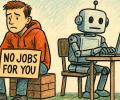
Generative AI is transforming workplaces but at a cost -- there are fewer jobs for young workers just entering the workforce, reveals a Goldman Sachs report.

Graphic designers, writers, testers, draftsmen and editors are seeing their traditional roles replaced by AI, warns Dr Anshuka Kulkarni, associate professor and head, School of Creative Studies, DYPU.

AI is changing jobs in India faster than ever, but professionals are learning the real skill isn't coding -- it's adaptability.

Top female executives are calling for corporate India to redesign workplace systems to support women's advancement into leadership roles in the technology sector, particularly in emerging fields like artificial intelligence.

The technology major confirmed that a 'low single-digit percentage' of its 270,000 employees would be affected in the fourth quarter of 2025.

Homegrown e-commerce giant Flipkart is experiencing a significant trend of senior leaders rejoining the company, driven by its people-first culture, opportunities for growth with ownership, and the chance to solve problems at an India scale.

The underrepresentation of women in the field of artificial intelligence (AI) poses a significant risk of perpetuating the prevailing societal biases into future technologies, according to a top Microsoft executive. Himani Agrawal, chief partner officer, Microsoft India and South Asia, believes that inclusion is a shared responsibility and if AI continues to be shaped without diverse perspectives, the biases of today risk becoming hardwired into the technology of tomorrow.

...compared with 153,000 in all of 2024.
Across all sectors, the future of work depends on adaptability.

Despite the alarming figures on job displacement, AI is expected to generate millions of new roles, echoing historical trends of technological transformation.
